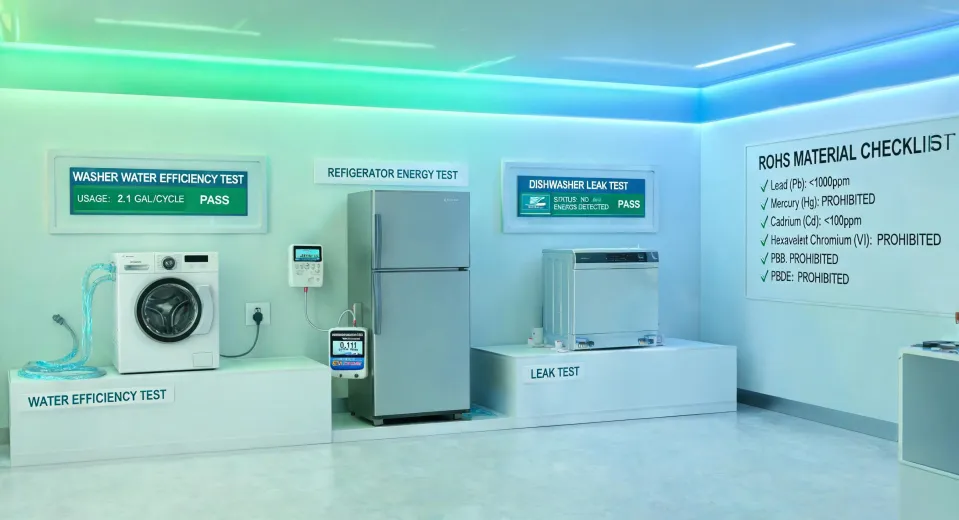
Maytag treats sustainability as a product and documentation discipline, not as a decorative brand claim. For B2B buyers, an efficient appliance is only useful when its performance can be explained to retailers, regulators, rebate programs and end users. That means energy labels, refrigerant choices, standby power, water consumption, material declarations and serviceability all need to be managed at SKU level. The Maytag roadmap is designed to help importers and distributors prove what they sell, not merely describe it.

The carbon roadmap begins with the appliance categories that create the largest downstream impact. Laundry platforms are reviewed for water efficiency, spin performance, motor configuration and standby consumption. Refrigeration programs are checked for compressor efficiency, insulation stability and lower-impact refrigerant paths. Dishwashers are evaluated through water consumption, heat-dry options, leak prevention and internal material compliance. For cooking and water-treatment appliances, we focus on electrical safety, heating efficiency, food-contact or water-contact declarations and component traceability.
Technology improvements are paired with practical documentation. Maytag organizes compliance records so buyers can see which products already support CE, UL, ETL, ENERGY STAR, RoHS or related market requirements, and which products need project-specific testing. Packaging changes are reviewed for carton strength and material reduction at the same time, because weak packaging can create more waste through returns and replacements. Spare-parts planning is also part of the sustainability picture: a product that can be serviced economically has a longer useful life and a lower total cost for the channel.
Control boards are reviewed for low-power modes and market-specific labeling.
Cartons are tested for protection before material reduction is approved.
Repairable assemblies and parts kits are mapped before shipment.
Partnerships matter because sustainability requests are rarely identical across markets. A European buyer may focus on ErP and material declarations. A North American utility program may focus on eligible efficiency documentation. A hospitality group may care most about durability, noise and service cycles. Maytag's role is to translate those requirements into appliance configurations, records and launch documents that buyers can trust before the first purchase order is placed.